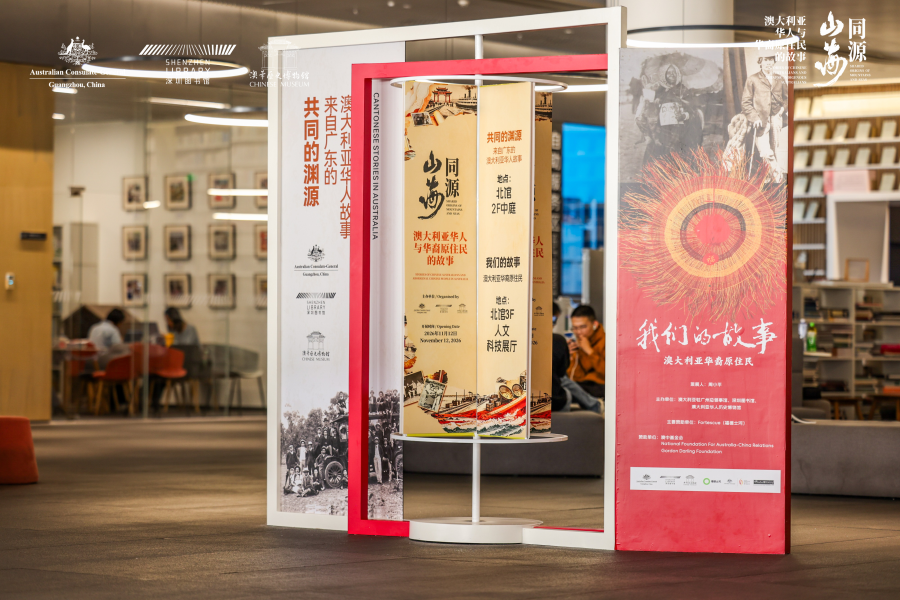
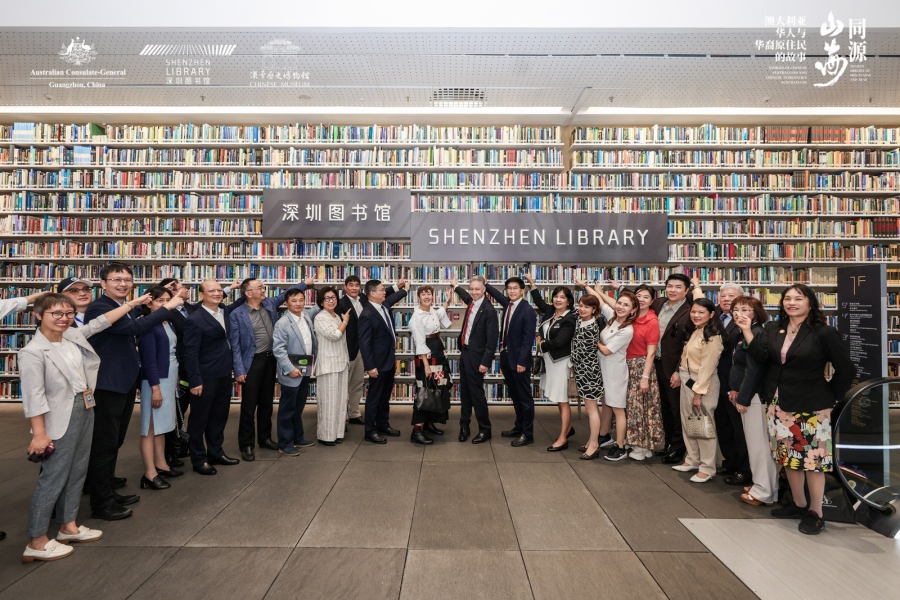
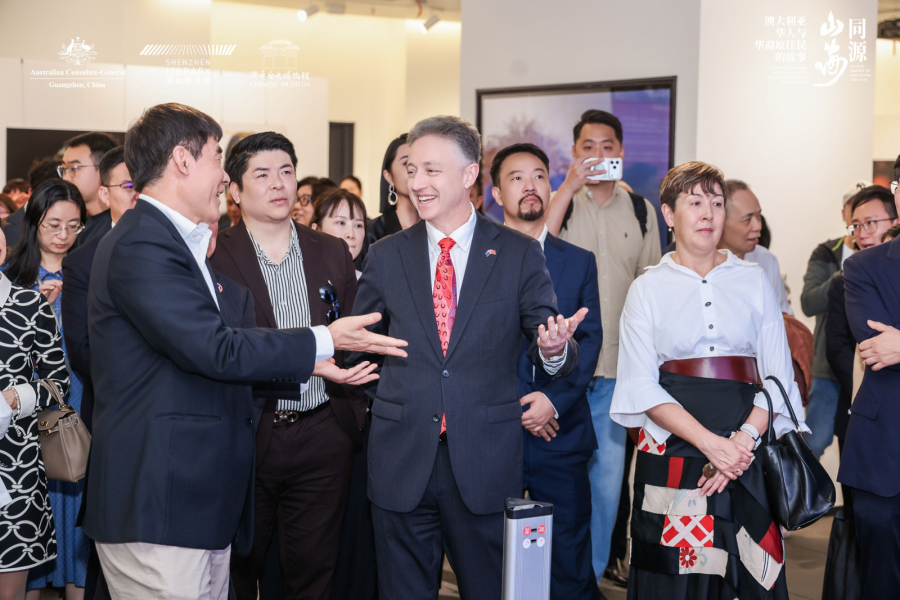
The countdown to the 2026 Asia-Pacific Economic Cooperation (APEC) summit in Shenzhen is under way. Australia was a founding member of APEC in 1989 and has continued to play an important role, reflecting its longstanding commitment to regional economic cooperation. To support APEC and welcome visitors from around the world, three Australian cultural exhibitions opened in Shenzhen on 12 November. These three closely connected exhibitions offer complementary perspectives on Chinese migration and Australian First Nations culture. Together, they tell a compelling story: Australia’s deep Indigenous roots, its successful multicultural society, and longstanding people-to-people connections with South China.
A Taste of Aboriginal Australia: Manjaree
A Taste of Aboriginal Australia: Manjaree is presented by Pingshan Exhibition Gallery, creating an immersive space for exchange. Centered on the concept of Manjaree—a traditional gathering place in what is now Fremantle, Western Australia—the exhibition brings together Australian Indigenous art, storytelling traditions and the ancient, continuing culture of the Nyoongar people. Through the striking photography and visual expression deployed by renowned Indigenous artist Wayne Quilliam, it reveals the depth and vitality of Indigenous culture. The exhibition’s project lead is award-winning Nyoongar entrepreneur Gerry Matera. He says the Shenzhen exhibition will provide an impactful way to share culture with Chinese audiences. “On my Country in Walyalup, Manjaree has for thousands of years been a place where people came to share stories, knowledge, trade, and celebrations. It is in the same spirit that we bring out exhibition to Shenzhen and invite Chinese audiences to experience Aboriginal culture in an art form that transcends barriers in language and culture,” he said. The exhibition also features an immersive digital experience based on the cycle of the six Nyoongar seasons, allowing visitors to experience the seasonal rhythms of the southern hemisphere through shifting light and imagery.Australian Indigenous culture is amongst the world’s oldest, spanning more than 60,000 years. Their distinctive cultural systems have endured through the Dreamtime, language, art, and oral storytelling.
Our Story: Aboriginal-Chinese People in Australia
Curated by renowned Chinese-Australian artist Zhou Xiaoping, Our Story: Aboriginal- Chinese People in Australia explores the sustained and little-known personal connections between Aboriginal and Chinese people in Australia, stretching back to the 1800s. It has exhibited at the National Museum of Australia and received grants from the National Foundation for Australia-China relations for exhibitions in Guangzhou and Xiamen. It now comes to Shenzhen Library’s north branch to meet audiences there. Did you know that acclaimed author Alexis Wright, a recipient of Australia’s highest literary award, also has Indigenous-Chinese ancestry? Her acclaimed novel Carpentaria is published in China and is available in Shenzhen Library’s collection. Wright has previously discussed her great-grandfather’s Cantonese heritage, describing how he overcame a perilous journey through Northern Australia, eventually settling in the Gulf of Carpentaria, where he used ‘Chinese knowledge and inspiration’ to tend the land. People of both Chinese and Indigenous Australian descent, such as Alexis Wright, have a distinctive dual heritage. Their life journeys and family stories vividly illustrate Australia’s cultural diversity.
Shared Connections: Cantonese Stories in Australia
Commissioned by the Australian Consulate-General in Guangzhou, in partnership with the Museum of Chinese Australian History, Shared Connections explores the story of Cantonese migration to Australia, highlighting the enduring contribution of Cantonese migrants and their descendants in Australia’s successful multicultural society. It may come as a surprise to many people that approximately 1.4 million Australians have Chinese ancestry. As early as the 1730s, people from South China began trading with Indigenous Australians. In the 1850s, the gold rush drew 40,000 Chinese workers to Australia, with around 90 per cent of them from Guangdong. Many Chinese migrants from Guangdong went on to establish market gardens, work in pearling, run laundries, make furniture, and open restaurants and hotels. Through commerce and settlement, Chinese people gradually became part of mainstream Australian society, laying the foundation for the future success of multicultural Australia. For audiences in Guangdong, this history of migration across the South Pacific has particular resonance. It is a history of connected families, a generation of Chinese people helping to shape a multicultural society, and is key to understanding contemporary people-to-people ties between Australia and China.
Source:Consulate General of Australia in Guangzhou
Editor: Wu Di
 打开广州日报新花城,享受流畅体验